A PastPresence line
Reading Companions
Reading with the author in the room. A companion reads alongside the reader and talks the book over from the inside: the text on one side, a researched presence of its author on the other, the page between them.
01
How a session works
Ask where the question occurs
This is not an annotated edition. A curious reader normally has to leave the page: a search engine, or a footnote that ends too soon. In companion mode the question is asked in place. The reader pauses on a passage, asks, and the companion answers with the page in view, in the voice of the author who wrote it.
The companion sees what the reader sees. A question about a word, a place, or a choice the writer made gets an answer grounded in the passage at hand, from the horse's mouth rather than a stranger's marginalia, and the reading continues where it left off.

02
What a companion knows
Sourced, bounded, reviewed
Each companion is authored from the public domain record of its author: the works themselves, letters, biographies, and the scholarship around them. The material is researched and prepared with university researchers and field experts.
The companion answers from that material, retrieved in the moment, and says when a question falls outside what it can defend.
The record
Published works in the public domain
Letters and biographical material
Scholarship, prepared with researchers and field experts
03
What it is not
A presence, held at a distance
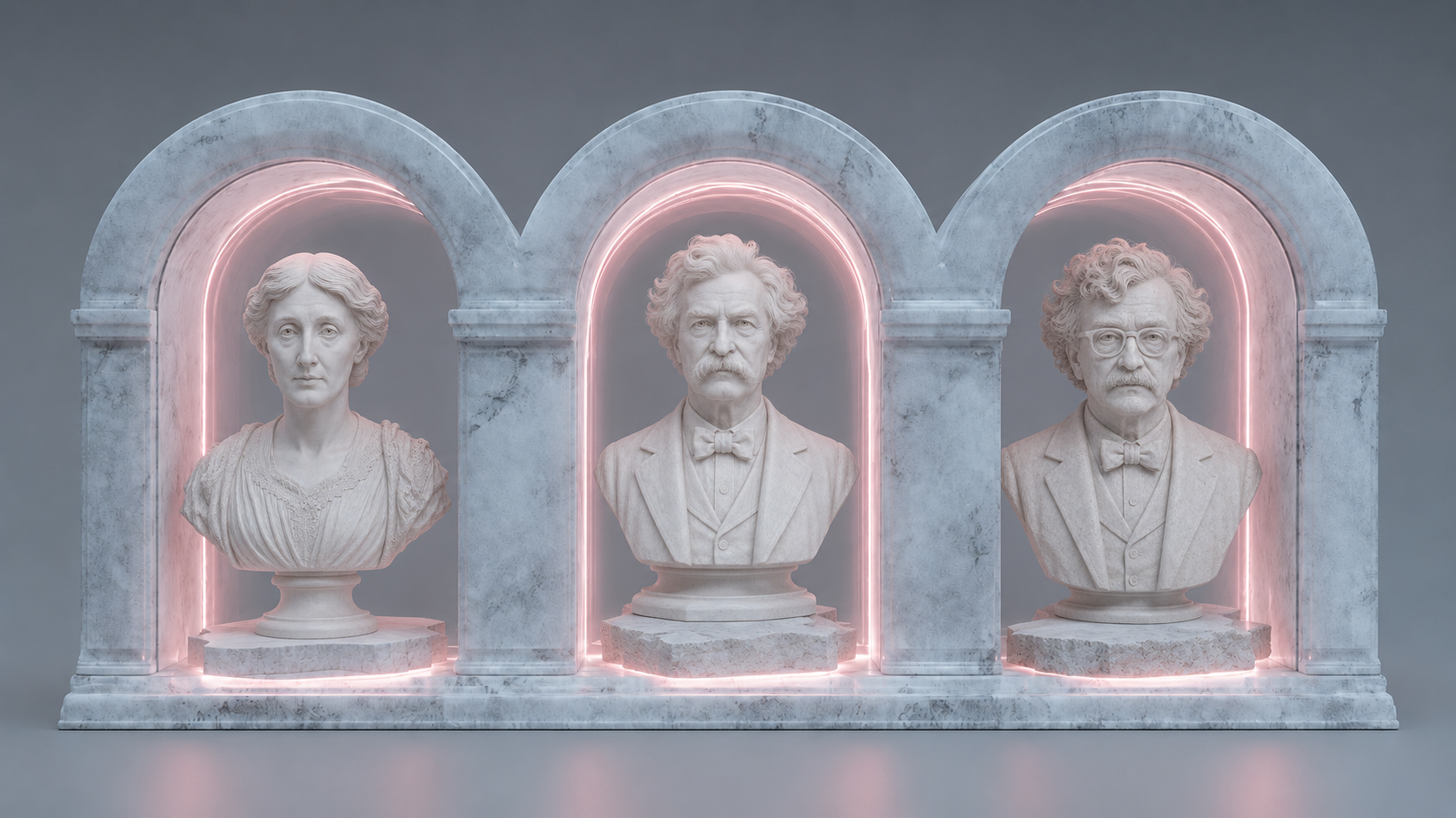
No one is asked to believe the author has returned. The companions are rendered as sculpted busts, sometimes as cloud and other ephemera, and the choice is deliberate: the form keeps a frank distance from the person while keeping the voice close to the work.
The aim is to bring the writing to life and to send the reader deeper into the work and its writer.
04
Voice or text
The register fits the room
A reader can speak with the companion aloud, or keep the whole exchange to a written thread: the right register for a library or a crowded train. The session is the same either way.
Reader goals shape the tone of the conversation without grade labels. Web readers can return to a companion that remembers where the conversation left off. Kiosk mode, built for institutions, retains nothing between visitors.
Modes
Spoken conversation, with the companion voiced
Written thread for quiet and public settings
Web mode with continuity; kiosk mode with none
Pilots
Pilots run with schools, libraries, and literary estates.